
Staying Connected in Nepal: SIM Cards, eSIMs, and Wi-Fi
If you are wondering how to stay connected in Nepal, the easiest option is to buy a local Ncell or Nepal Telecom SIM card for tourists when you arrive, or install an eSIM for Nepal before your flight. A local SIM is inexpensive and gives you a Nepalese number, while an eSIM is convenient if your phone supports it and you want to be online as soon as you land.
For most travelers, the best setup is simple: use a local SIM or eSIM in Kathmandu and the major tourist areas, rely on Wi-Fi when available, and expect connectivity to become slower and less predictable once you head into the Himalayas.
Do You Need a SIM Card in Nepal?
You do not have to buy a local SIM card to travel in Nepal. Hotels, restaurants, cafes, airports, and many tourist businesses offer Wi-Fi, and you can also use your home carrier's international roaming if your plan includes Nepal.
However, a local SIM is usually the more practical choice if you are staying for more than a few days.
A Nepal SIM card for tourists gives you affordable mobile data for maps, ride apps, WhatsApp, email, translation, bookings, and contacting your hotel or guide. It is especially useful when you are traveling outside Kathmandu and Pokhara, where Wi-Fi may not always be available.
For trekkers, having mobile data is helpful at lower elevations, but you should not assume that a SIM will keep you connected throughout an entire Himalayan trek.
Buying a SIM Card at Kathmandu Airport
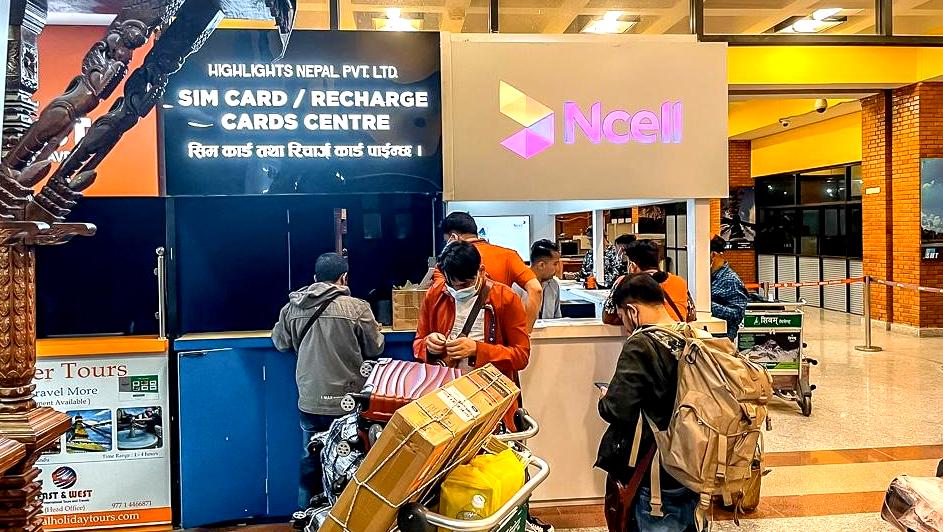
One of the easiest places to get connected is Tribhuvan International Airport (TIA) in Kathmandu. Ncell has a tourist SIM counter at the airport, and its tourist plans are specifically designed for international visitors.
What do you need?
Bring your original passport; a passport photo is occasionally requested, so carry one if you have it.
How much does a tourist SIM cost?
Ncell currently lists these tourist plans:
| Ncell tourist plan | Validity | Current price | Data before throttling |
| TouristPro Sprinter | 7 days | NPR 595 (about $4) | 10 GB |
| TouristPro Explorer | 14 days | NPR 995 (about $7) | 25 GB |
| TouristPro Voyager | 28 days | NPR 1,995 (about $14) | No cap |
Sprinter and Explorer include unlimited data subject to their respective high-speed data allowances; after the stated allowance, speeds are throttled. Voyager does not have a listed data cap.
The plans also include unlimited all-network voice calls and 100 SMS, subject to Ncell's applicable terms and fair-use policy.
Ncell states that tourist plans are available at Tribhuvan International Airport, Ncell centers, and authorized retailers around Nepal. Tourist eSIM versions are also available online.
How long does it take?
If the airport counter is not busy, buying and activating a SIM should be a relatively quick arrival task. Allow extra time during busy periods because registration, identity verification, and activation all have to be completed before you leave the counter.
Tip: Test your mobile data before walking away. Open a website or send a WhatsApp message so you know the SIM is working.
Ncell vs Nepal Telecom: Which Is Better?
The Ncell vs Nepal Telecom question does not have one universal answer. Both are major Nepalese networks, and the better choice depends largely on where you are traveling.
A useful rule of thumb is: Ncell is a convenient choice for cities and popular tourist areas, while Nepal Telecom can be particularly useful when you are heading into rural and mountain regions. That distinction matters more if you are trekking.
Ncell
Ncell is widely used in Kathmandu, Pokhara and other populated areas. Its tourist plans are straightforward, and the company offers dedicated tourist SIM and eSIM packages with data and voice included.
For a traveler spending most of the trip in Kathmandu, Pokhara, Chitwan, and other established tourist destinations, Ncell is an easy option.
Nepal Telecom
Nepal Telecom (NT), also known as NTC, has a very extensive national network and can be useful in rural areas and on trekking routes. Current trekking information indicates that NTC can retain useful coverage in sections where Ncell becomes less consistent.
This does not mean NTC works everywhere in the mountains. Himalayan geography is the bigger limitation: once you reach higher elevations, both networks can become intermittent or disappear completely.
So which one should you buy?
For a city-focused Nepal trip: Ncell is a simple choice.
For a trek-heavy itinerary: Nepal Telecom is worth considering, particularly if your route goes into remote mountain areas.
For important communication: If staying connected is critical, do not depend on one network alone. A local SIM plus lodge Wi-Fi or another communication option gives you a useful backup.
eSIM Nepal: Is It Better Than a Physical SIM?
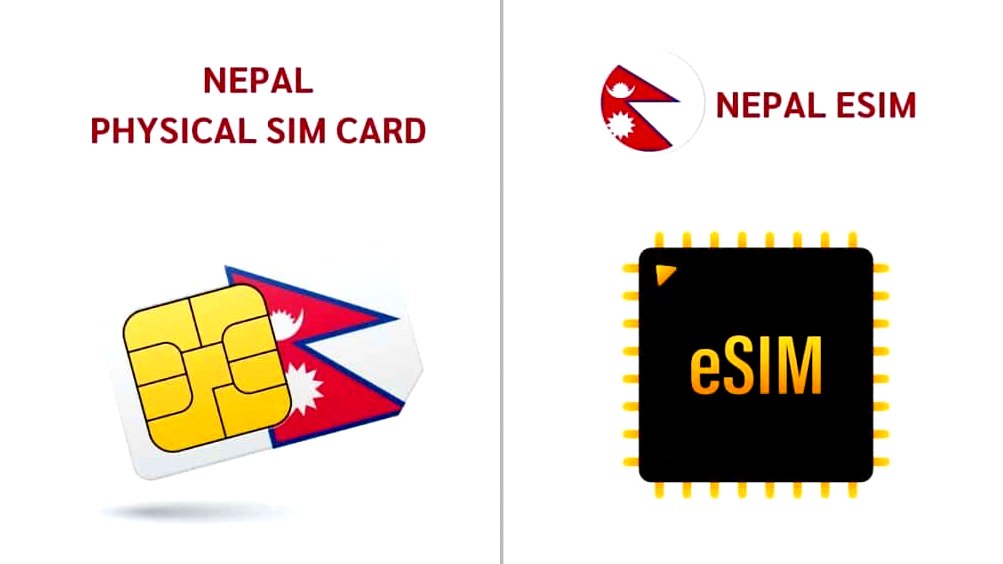
An eSIM Nepal plan can be the easiest option for travelers with a compatible, unlocked phone.
Instead of collecting a physical SIM after landing, you purchase and install a digital SIM before your trip. Your phone can then connect to a supported Nepalese or international network when you arrive.
Ncell offers tourist eSIM plans that can be purchased online, while Nepal Telecom also operates an eSIM service for compatible devices.
Why choose an eSIM?
An eSIM makes sense if:
-
Your phone supports eSIM.
-
You want data immediately after landing.
-
You do not want to remove your home SIM.
-
You are comfortable installing the eSIM yourself.
-
You mainly need data rather than a Nepalese telephone number.
It is particularly convenient for travelers who want to keep their US number active for incoming messages while using the eSIM for mobile data.
What does an eSIM cost?
International Nepal eSIMs commonly fall into the roughly $8–$20 range for smaller data packages, depending on the provider, validity and amount of data. Local operator tourist eSIMs can be priced differently.
Always check the current price before purchasing because eSIM plans change frequently.
The catch: you may not get a local number
This is one of the biggest differences between an international travel eSIM and a local SIM.
Many international eSIMs are data-only. That means you can use WhatsApp, iMessage, email, Google Maps and other internet-based services, but you may not receive a Nepalese mobile number for ordinary local calls or SMS.
If you need a Nepalese number for local communication, a physical Nepal SIM or a local operator eSIM is the better option.
Wi-Fi in Nepal: What Should Travelers Expect?
Wi-Fi in Nepal is widely available in cities and tourist areas.
Hotels, restaurants, cafes and guesthouses in Kathmandu and Pokhara commonly provide Wi-Fi, and you can usually use it for messaging, email, social media and video calls.
The situation changes when you leave the cities.
In rural Nepal, Wi-Fi availability depends on the location and infrastructure. In trekking areas, many lodges and teahouses offer paid Wi-Fi, but the connection can be slow or unreliable, particularly at higher elevations.
For this reason, think of Wi-Fi as a useful supplement to mobile data rather than your only connection.
Internet on the Everest Base Camp Trek
If you are asking, "Will I have internet on the Everest Base Camp trek?" the answer is yes—but not continuously.
Connectivity is generally strongest around lower sections such as Lukla and Namche Bazaar. As you climb higher toward Tengboche, Dingboche, Lobuche and Gorak Shep, mobile coverage becomes increasingly inconsistent.
At Everest Base Camp itself, you should not plan your trip around having ordinary mobile data or reliable public Wi-Fi.
This is where many travelers make a mistake: they buy a Nepal SIM and assume that having a strong data plan means they will have internet everywhere. The plan determines how much data you can use; it does not create a signal where there is no network infrastructure.
For more detailed information about communication on the Everest route, see our guide to Communication During Everest Region Trekking, which covers mobile networks, Wi-Fi, satellite communication, and charging options.
Where Does Mobile Data Work on the Everest Trek?
The exact signal can change because of terrain, weather, tower availability, and even where you are standing in a village. But the general pattern is useful for planning.
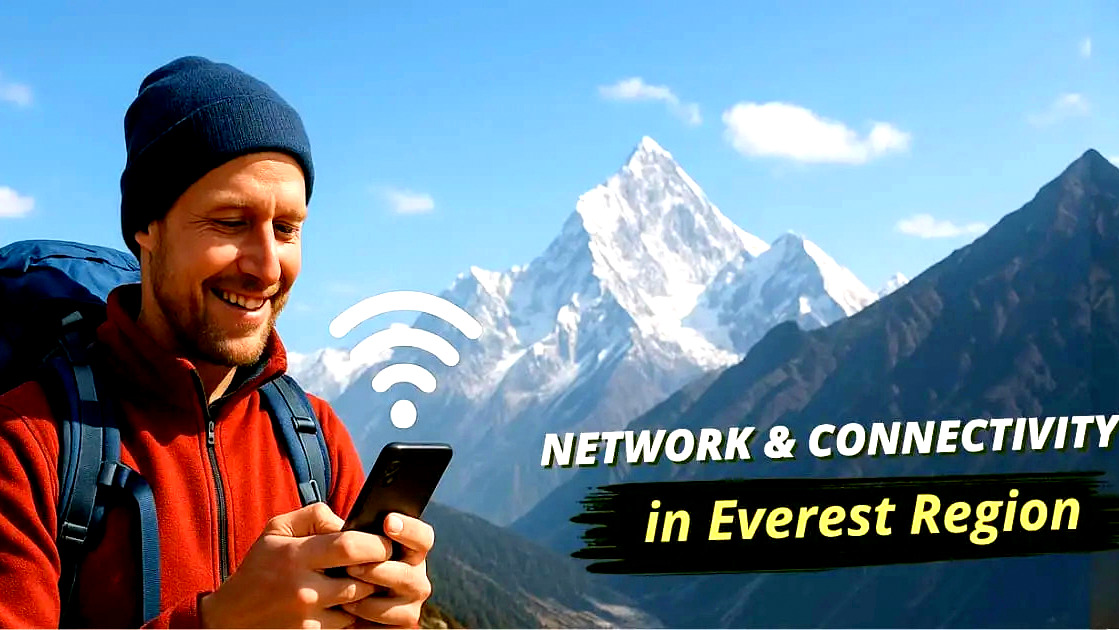
Lukla: Lukla has comparatively good connectivity, and both Ncell and Nepal Telecom can provide mobile service here. It is a good place to download anything you may need before going farther into the mountains.
Namche Bazaar: Namche is one of the best-connected stops on the Everest Base Camp route. Both mobile networks and paid Wi-Fi are available, making it a useful place to contact family, download files, and update maps.
Tengboche and Dingboche: Connectivity becomes more variable as you climb. You may find mobile data in some locations, but speeds and reliability can fluctuate. Do not schedule an important work video conference assuming you will be able to connect.
Lobuche: Mobile coverage becomes much less dependable around Lobuche. Wi-Fi may be available, but you should treat it as a convenience rather than a guarantee.
Gorak Shep: Gorak Shep is one of the highest overnight stops before Everest Base Camp, and connectivity is limited. Wi-Fi can be available through Everest Link or individual teahouses, but it can be slow and expensive compared with Kathmandu.
Everest Base Camp: Do not expect normal tourist Wi-Fi or mobile data at Everest Base Camp. Expedition teams may have their own satellite communication systems, but those are not the same as a public internet connection available to trekkers.
How Much Does Teahouse Wi-Fi Cost?
Wi-Fi prices vary between lodges and can increase as you climb.
Around NPR 700–800 (about $5–6) for 24 hours in Namche Bazaar is a useful current benchmark, while prices can rise to around NPR 1,000 or more at higher elevations. Other teahouses may charge by the hour or offer different data packages.
A rough guide:
| Location | Typical Wi-Fi situation |
| Lukla | Relatively accessible |
| Namche Bazaar | Good by trekking standards; around $5–6 for 24 hours in some locations |
| Tengboche | Available in some lodges, but less reliable |
| Dingboche | Slower and less consistent |
| Lobuche | Limited |
| Gorak Shep | Often slow, intermittent or unavailable |
| Everest Base Camp | No regular public Wi-Fi |
Everest Link operates Wi-Fi hotspots at numerous locations in the Khumbu, including Lukla, Namche Bazaar, Tengboche, Dingboche, Lobuche and Gorak Shep.
Important: Prices and availability can change between seasons and individual teahouses. Carry some Nepalese rupees rather than assuming you can always pay by card or phone.
What About the Internet on the Annapurna Circuit?
The Annapurna region has also become considerably more connected, particularly around major villages.
Places such as Manang and Jomsom generally have better connectivity than the most remote sections of the route. Wi-Fi is available in many teahouses and lodges, while mobile coverage varies by location and altitude.
In Manang, teahouse Wi-Fi can commonly cost around NPR 500–800 (roughly $4–6) depending on the lodge and package. Speeds can vary considerably, so it is better suited to messages, email and basic browsing than large uploads or video calls.
Near Thorong La Pass, however, you should expect connectivity to be limited or absent.
The same principle applies throughout Nepal's trekking regions: download what you need before heading into remote sections and never make your safety plan dependent on a phone signal.
How to Stay in Touch With Family Back Home
For travelers from the US, staying connected is often less about posting photos and more about letting family know that everything is okay.
A simple communication plan works best.
Before you leave Kathmandu
Send your family your trekking itinerary, including:
-
Trek route
-
Expected duration
-
Major overnight stops
-
Trekking company or guide contact
-
Hotel details
-
Approximate days when communication may be limited
Use WhatsApp
WhatsApp works in Nepal when you have an internet connection, whether that connection comes from mobile data or Wi-Fi.
You can use it for:
-
Text messages
-
Voice calls
-
Video calls
-
Voice notes
-
Photo sharing
-
Location sharing
The important point is that WhatsApp needs an internet connection. Having the app installed does not mean it will work where there is no mobile signal or Wi-Fi.
Set a communication routine
Rather than promising your family that you will be reachable all day, tell them when you expect to check in.
For example:
"I'll message you from Namche, then again when I reach Dingboche. If you don't hear from me for a day, it may simply mean there is no reliable connection."
That small conversation can prevent unnecessary worry.
Picture idea: American traveler sending a WhatsApp message to family while sitting inside a Himalayan teahouse.
Practical Tips for Staying Connected in Nepal
1. Install important apps before you fly
Download Google Maps, offline maps, translation tools, airline apps, hotel confirmations and trekking information before leaving home.
2. Download maps for offline use
Do not rely completely on mobile data for navigation. Download the areas you will visit while you still have reliable Wi-Fi.
3. Keep your home SIM active if necessary
If you need to receive US bank verification codes or other important SMS messages, check your carrier's roaming settings before traveling.
4. Turn off data roaming on your home SIM
If you use a local SIM or travel eSIM for data, make sure your US SIM is not accidentally using expensive international data.
5. Carry a power bank
Connectivity is only useful while your phone has battery. A high-capacity power bank is particularly useful on treks, where charging can become expensive or limited at higher elevations.
6. Save important phone numbers
Keep your hotel, trekking company, guide, travel insurance provider, and emergency contacts saved offline.
7. Don't wait until the mountains
Download maps, permits, confirmations, and entertainment before leaving Kathmandu or Pokhara.
8. Tell family when you may be offline
This is especially important on longer treks. A few hours or even a day without a message does not necessarily mean something has gone wrong.
Should You Use Your US Phone's Roaming?
You can, but check the cost before you arrive.
International roaming prices vary dramatically between US carriers and individual plans. Some premium plans include international data, while others charge per day or by data usage.
If your carrier offers affordable Nepal roaming, it may be convenient for a short trip.
For longer stays, however, a local SIM or eSIM is often more economical.
A useful compromise is to keep your US SIM active for calls and verification texts while using a Nepalese SIM or travel eSIM for mobile data.
Our Recommendation: The Best Setup for Most Travelers
For most visitors to Nepal, you do not need an expensive connectivity package.
If you are visiting Kathmandu, Pokhara and Chitwan: Buy an Ncell tourist SIM at the airport or use a suitable eSIM.
If you are trekking: Consider Nepal Telecom or Ncell, depending on your route, and use teahouse or Everest Link Wi-Fi as a backup.
If you want convenience above everything else: Install a Nepal eSIM plan before you fly.
If staying connected to family is essential: Use a local SIM/eSIM, keep your home number available where necessary, download offline information, and tell family in advance when you may lose service.
If you need guaranteed communication in remote areas: Talk to your trekking company about emergency communication options rather than relying on ordinary mobile service.
Ready to organize the rest of your Nepal trip? Plan your trip with our team.
For more practical information for US visitors, read Is Nepal Safe for American Tourists? 2026 Update.
Frequently Asked Questions
Q. Can you buy a SIM card at Kathmandu airport?
A. Yes. Ncell offers tourist SIM cards at Tribhuvan International Airport in Kathmandu. You need your original passport for registration and activation. Airport SIMs are convenient because you can get connected immediately instead of searching for a telecom store after arriving in the city.
Q. Is there Wi-Fi on the Everest Base Camp trek?
A. Yes, Wi-Fi is available at many teahouses and lodges along the Everest route, particularly around places such as Namche Bazaar. Availability becomes less reliable as you climb higher. At Everest Base Camp itself, do not expect normal public Wi-Fi.
Q. Which network is best for trekking in Nepal?
A. There is no single network that works best everywhere. Ncell is convenient in cities and popular tourist areas, while Nepal Telecom can be useful on rural and mountain routes. Coverage changes with terrain and altitude, so trekkers should not rely entirely on either network.
Q. Does WhatsApp work in Nepal?
A. Yes. WhatsApp works in Nepal when your phone has an internet connection through mobile data or Wi-Fi. You can use it for messages, voice calls, video calls and photo sharing. Remember that WhatsApp cannot connect when you are completely outside mobile and Wi-Fi coverage.
Q. Is eSIM Nepal available for tourists?
A. Yes. Ncell offers tourist eSIM plans online, and Nepal Telecom also provides eSIM services. An international travel eSIM is another option. Check that your phone is unlocked and eSIM-compatible before buying a plan.
Q. Do I need a passport to buy a SIM in Nepal?
A. Yes, identification is required for SIM registration. Ncell's tourist SIM instructions require the original passport for registration and activation. A passport photo is occasionally requested, so carrying one can be useful even when it is not required.
Q. Can I use my US phone in Nepal?
A. Yes, provided your phone is unlocked and compatible with the local network or eSIM you choose. You can keep your US SIM for calls and verification messages while using a Nepalese SIM or travel eSIM for data.
Q. Will my SIM work at Everest Base Camp?
A. You should not rely on ordinary mobile service at Everest Base Camp. Connectivity becomes increasingly limited as you climb, and there is no dependable public mobile or Wi-Fi service at Base Camp itself. Plan to communicate from connected villages and teahouses instead.
Q. How much does Wi-Fi cost on the Everest Base Camp trek?
A. Prices vary by location and teahouse. Around Namche Bazaar, 24-hour Wi-Fi can cost roughly NPR 700–800, or about $5–6. Prices may increase at higher elevations, where internet infrastructure is more expensive to operate.
Q. Should I buy a SIM or eSIM before traveling to Nepal?
A. Choose an eSIM if convenience is your priority and your phone supports it. Choose a local SIM if you want a Nepalese number and potentially lower local data costs. For trekkers, either option can work at lower elevations, but neither guarantees coverage high in the Himalayas.
Final Takeaway
Staying connected in Nepal is easier than many first-time visitors expect. A Nepal SIM card for tourists or eSIM can keep you online throughout cities and much of your regular sightseeing, while Wi-Fi provides another easy option at hotels and cafes.
The mountains are different. On the Everest Base Camp trek and other Himalayan routes, connectivity becomes increasingly dependent on location, altitude, local mobile towers, and teahouse Wi-Fi. Buy your SIM before trekking, download what you need offline, carry a power bank, and tell family when you may be unreachable.
That way, you can stay connected when it matters without spending your entire Nepal trip looking for a signal.
If you need any further information, please contact us, Email: [email protected], Phone: +977- 985 100 5129 (WhatsApp)


Tripadvisor
5.01110 reviewsGoogle
4.8154 reviewsFacebook
4.1 recommend44 ReviewsTrustpilot
4.1 Great(12 reviews)- Trusted by50K plus traveller